The Jack Judge bronze statue in Stalybridge was the fourth of six commissioned bronze sculptures created by Escar UK Bronze for Tameside Council in Greater Manchester
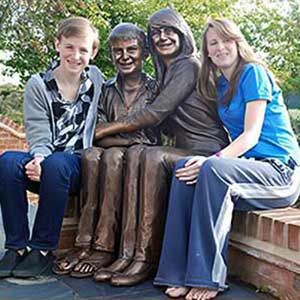
This hollow-cast bronze sculpture shows Jack Judge seated on a granite rock studying a Tipperary song sheet; a First World War soldier leans over his shoulder while playing a mouth organ
The Jack Judge memorial statue stands in Lord Pendry Square on Trinity Street, outside Stalybridge Civic Hall, the former Victoria Market Hall; it is close to the site of the Grand Theatre, where Judge performed the song in 1912
The statue was unveiled on 16 December 2005 by Councillor Frank Robinson, with a local brass band taking part in the ceremony
Fittingly, several members of the Judge family were also in attendance to honour him
The plaque is carefully phrased to sidestep controversy by stating that the song was conceived in Stalybridge, rather than composed there as is widely believed
This wording is used because many people contest this claim, asserting instead that the song was written in his hometown of Oldbury


Jack Judge, born in 1872 in Oldbury, was a music-hall entertainer and songwriter best remembered for his association with the song It’s a Long Way to Tipperary, published with credit to Judge and Harry Williams
Judge’s family had Irish roots in County Mayo; the song’s history is linked with an earlier number, It’s a Long Way to Connemara, associated with his writing partnership with Harry Williams
Despite his humble beginnings, his gift for writing memorable tunes soon set him apart
Jack, a consummate performer with a perfect voice for music hall, began supplementing his main income as a fish seller by taking to the stage in order to support his growing family
Judge performed at a variety concert in Birmingham in 1909 with John Bull’s Cold; his music-hall career developed alongside the publication and sale of his songs
The origins of It’s a Long Way to Tipperary have long been disputed; the familiar Stalybridge story should be read alongside the published credit to Jack Judge and Harry Williams
According to the well-known account, during his January 1912 engagement at the Grand Theatre in Stalybridge, Judge accepted a bet to produce and perform a new song by the following evening
Other accounts connect the song with the earlier It’s a Long Way to Connemara, associated with Judge and Williams; this background makes the idea of an entirely new overnight composition uncertain
Judge performed It’s a Long Way to Tipperary at the Grand Theatre on 31 January 1912; it later became internationally associated with soldiers during the First World War
It’s a Long Way to Tipperary is a music-hall song first performed by Jack Judge in 1912 and later adopted as a marching song; published sheet music credits Jack Judge and Harry Williams
It’s a long way to Tipperary,
It’s a long way to go,
It’s a long way to Tipperary,
To the sweetest girl I know!
The well known chorus is:
Goodbye Piccadilly,
Farewell Leicester Square,
It’s a long long way to Tipperary,
But my heart’s right there!
Jack penned dozens of music hall songs, with his first major hit being ‘How Are Yer?’ in 1912
Other popular songs included
‘Michael O’Leary’
‘Paddy Maloney’s Aeroplane’
‘Sing a Song’
‘The Magic of Cremalt’
‘The Way the Wind Blows’ and ‘When the Band Begins to Play’
Despite his many compositions, none achieved the same level of fame as ‘It’s a Long Way to Tipperary’
As World War One unfolded, ‘It’s a Long Way to Tipperary’ was adopted by British soldiers as a marching song
Its themes of homesickness and hope struck a chord with the troops and the song spread rapidly throughout the ranks, instantly becoming an international hit
On 13 August 1914, George Curnock of the Daily Mail, while on holiday in Boulogne, observed the British Expeditionary Force landing in France
He noted that familiar tunes like ‘Soldiers of the Queen’ and ‘Dolly Grey’ were also followed by a new poignant song, sung by Irish voices
Curnock’s report on the ‘Tipperary’ song was cabled worldwide, people everywhere embraced it, and the song became an anthem for British soldiers during the war, symbolising the resilience of those stationed on the front lines despite their longing for home
-:-
Wikipedia -:- For more information on the Art of Lost Wax Casting -:- The Crucible
The Jack Judge memorial statue is in Lord Pendry Square on Trinity Street, outside Stalybridge Civic Hall, formerly Victoria Market Hall; it commemorates the town’s connection with the performer and the song It’s a Long Way to Tipperary
The statue was unveiled on 16 December 2005 by Councillor Frank Robinson, with members of the Judge family attending; the photographs on this page show the unveiling and the finished commission
Jack Judge is seated on a granite rock studying a song sheet while a First World War soldier leans over his shoulder and plays a mouth organ; the pairing connects the music-hall performer with the song’s later popularity among soldiers
The bronze sculpture was modelled by John Cox and made at Escar UK Bronze, as recorded in the Trinity Street local-history account; the concept drawings shown here are by Julie Wilkinson It was part of Tameside’s commissioned heritage sculptures
Judge performed It’s a Long Way to Tipperary at the Grand Theatre in Stalybridge in January 1912; the song became strongly associated with the First World War Published sheet music credits Judge and Harry Williams, and accounts of how the song originated differ
For a bespoke public or private sculpture, see our bronze commissions page to discuss the subject, references, size and setting