
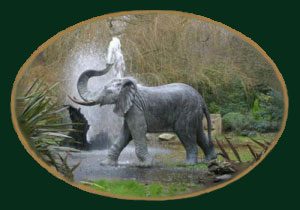
Let Escar UK Bronze guide you through the 6,500-year-old Lost Wax Bronze Casting Process used to create the Hollow Cast Bronze Statues & Sculptures
The high costs involved in producing a sculpture using the traditional lost wax process is not purely due to the price of the bronze metal
This casting method Is a complex process, involving multiple areas of expertise, from the flair of the artists creating the original image and wax model, to the knowledge and specialisation required to successfully cast the bronze, through to the skill required to achieve the final patina
The hands-on nature of the process means that each casting is unique and no piece is an exact duplicate of the original firing wax, as these are individual pieces and not mass-produced
Although these differences are subtle, they are on the whole, not easily noticeable
Creating a realistic and finely detailed bronze sculpture begins with extensive research, starting with a collection of photos of the subject, used for reference purposes
Extra special consideration is given to photos that capture the facial expression, both the the artist & commissioner wish to immortalise in the final sculpture
By meticulously studying and selecting these photos, the artist can craft a lifelike and meaningful sculpture in bronze, that faithfully represents the subject
If necessary, a sketch may be produced and presented to the customer for confirmation that this is indeed, an accurate representation of the finished bronze they have in mind
The artist creates a model using materials such as wax, clay or other oil-based substances, that remain soft and workable
We at Escar UK Bronze prefer to use modelling wax as there is no need to fabricate an armature (a framework that supports a sculpture if it can’t stand on its own) as is required with clay
By using various pre-made modelling waxes, the artist has the luxury to customise the hardness of the material according to the project’s needs, simply by mixing the various types and using additives
Also waxes sensitivity to temperature is a major advantage over clay, as different waxes behave differently, at differing temperatures
When cold, modeling wax is hard & rigid and suitable for carving, when warm, it becomes soft and pliable, which is ideal for shaping and moulding
It can also be heated in a pot and painted on with a brush to create thin layers, or when slightly cooled, applied with a spatula or knife, if thicker layers are required
When completely cool, wax is able to capture a higher level of detail, that unfortunately, is difficult to obtain with clay
Allowing wax to cool and harden between sessions means a modeling project can be paused and later resumed, without drying out like clay. This feature is particularly useful when awaiting feedback on a commissioned sculpture
Another huge advantage of modelling wax over clay is that it can be reused almost indefinitely, and if well looked after, is an ideal substrate to rework a concept many times over
And last but not least, modelling wax can be added or removed with ease
A mould of two shell-like halves is made from the original wax model with each having two layers, one inner and one outer
The inner layer is normally created by painting layers of latex or silicone onto the wax model to a defined thickness, which perfectly captures the fine detail the artist has imparted into the wax. It is then left to dry
The outer layer is commonly made from plaster or fibreglass, to support and protect the soft mould within
During this process, flanges with built-in male to female register pegs are added to the outside around the middle. This is to facilitate splitting the inner and outer shell into two equal halves when cured and more importantly, to ensure the two halves match up perfectly when re-assembled
Holes may also be drilled around the flange if necessary, to allow the two halves to be bolted together to prevent any movement after they have been carefully aligned
When cured, the moulds are then carefully separated to produce two halves, and removed from the artist’s wax
The two halves are then carefully re-assembled to become a whole and molten wax is poured inside and swirled around to allow an even layer to coat the inner surface
Every artist is different and will have found their own preferred quantities of wax to make their ideal cast
In large castings, the wax is painted on until the required thickness is achieved, normally around 3mm
It is then allowed to cool, or force cooled with cold water if the mould is small, resulting in a hard hollow wax positive copy, of the mould it came out of
Once the wax is set, the mould is then removed from wax positive and used over and over again if it is a batch order
Once the order is completed, the two halves are then put into storage for making duplicates, should they be required for future orders
At some point, the positive copy is “Chased” on the outside if necessary, to remove any imperfections
Chasing is where a heated metal tool is used to smooth out and hide any imperfections in the wax positive and to remove the line that is produced by using a mould of two halves
A hole is scooped out of a pile of sand, the mould is then inserted upside down into it and sand built up around it, to give it support
A ceramic slurry is hand mixed from powder and water and a scoop of sand added to give it extra strength, which is then poured into the inverted wax positive and left to set
Once the slurry has set, the wax positive is removed from the sand and now forms the inner half of the mould
In larger castings, ‘Spruing the Wax’ is where wax is rolled into long solid cylindrical shapes and added to the outside of the wax model
This is done to create hollow tunnels through which the molten wax can run out once heated and leave behind hollow tubes to allow air to escape, as the molten bronze is poured in
The sprued wax model is then covered in slurry of silica and sand stucco inside and out, the same as the small castings only on a larger scale
If it is too big, or long and narrow, then the slurry on the outside is left to set, then the mould is separated into two halves and coated with slurry on the inside
These are known as the Inner and Outer Ceramic Shell Moulds
This process is repeated until half an inch of ceramic shell mould coats the wax mould, which is then bound with wire and further slurry applied on top, to give it strength
Depending on the shape of the object to be cast, they maybe joined together together first and be cast as one, or they may be cast separately and welded together after casting
Once the ceramic inner and outers are hard, metal pins are hammered into the outer shell, on though the wax and into the inner core, to keep the inner and outer moulds in alignment once the wax is melted and poured away
Before the molten bronze is added, the mould will first be inspected for any weak points or holes where leaks may occur
Any damage is then repaired, holes patched and should they be required, additional holes made to aid wax draining
For a large castings, holes are made around the base and plugged with wax
First, large slow burning logs are set under and around the moulds
Then the kiln is built around the moulds using breeze blocks, and a metal roof added above to contain the heat within
Kindling wood is then placed in the space between the logs and the inner walls of the kiln, fired and tended as required
The wood is then left to slow burn overnight, so the moulds are brought up to temperature to prevent the hot molten metal from cracking them, when it is poured in the following day
During this time, the wax will melt, flow out of the holes in the base of the moulds, as well as providing additional fuel for the fire
It is at this stage our process gets it’s name, ‘The Lost Wax Bronze Casting Process’
A separate kiln is used to melt the bronze metal ingots
The furnace again uses wood for fuel, but a blower is also employed to force air into the furnace to help raise the temperature to the required 1200°C
Once the bronze metal is nearing its molten state, the mould kiln is dismantled and the ash from the wood burn cleared away
This leaves a clear space around the moulds to allow drain holes to be plugged with ceramic slurry, to prevent molten metal from escaping, during the pour
Once the plaster has set and the bronze is in it’s molten state, it is time to transfer it to the mould’s in a crucible and start casting
It is carefully poured in through the prepared holes in the top until the interior of the mould is full, and is then left to cool and solidify
It is this careful control of temperature and gradual cooling that ensures the final cast, maintains its desired shape and structural integrity
The process highlights the importance of temperature management in molten metal casting, not only to prevent damage, but to also to ensure a high-quality final product
When cool, the bronze casting is released by drilling out the inner core, hammering and breaking away the outer shell and cutting off the sprues
The sprues now replaced by bronze, will be melted down and used again, but the ceramic inner and outer shells are destroyed
Finally we have bronze cast of the original sculpted model, which is then prepared for Patination
The larger the cast that has been broken out of the plaster mould, the rougher it usually turns out to be, so there is still a long way to go, before the raw cast bronze is ready for patination
Bronze metal chasing is employed to remove all signs of casting, only this time using metal grinders
This can also be referred to as, ‘Fettling’
Grinding off rough pieces of bronze that got cast into any gaps in the two halves of the moulds
Welding bronze metal into parts that didn’t get cast properly, due to a variety reasons such as trapped air or moisture, etc.
Imperfections or pits from air bubbles can be dealt with by filling with molten bronze and re-finishing
If the subject was too large to be cast in one piece, any additional pieces that were moulded separately would also be added at this point, and the welds dressed
The next stage is to add the fine features like fur or feathers, using grinders and Dremel tools equipped with various sizes of grinding bits, suitable for the task
Finally we have a finished bronze cast of the original sculpted model, which is then prepared for Patination
This is the art of colouring the sculpture by applying various chemicals, different combinations of which create various colours, and heating the surface with a blow torch
Once patinated, the sculpture is then protected with layers of wax applied under heat, followed by two cold applications and then buffed to reach a fine lustre
Over time and after repeated use, the definition will be reduced and a new mould will need to be fashioned
Also because of the fragile nature of silicon, sometimes the inner moulds get damaged
This is something we keep a close eye on to ensure that our current moulds produce a finely detailed firing wax, to the quality of the original
If degradation occurs, the current wax is returned to the artist, lost details reinstated, new moulds are created and the old moulds are scrapped
As can be seen from the narrative above, the Art of Bronze is an age-old, hands-on process that goes through many stages before the final sculpture is ready for delivery to the customer
We do hope the information contained within has been informative, and gives an insight into the amount of work that goes into producing a traditional Lost Wax Cast Bronze